Aug 1, 2025
AI in law? It sounds great - until you ask a lawyer whether they can send confidential documents to OpenAI’s servers.
Gaius Lex is an AI assistant for lawyers and tax advisers that works differently from anything we’ve seen in legal tech so far. Instead of relying on large language models running in the cloud, Gaius uses lightweight, local sLLM models that can also run on‑premise, i.e. on dedicated servers directly at the client’s site. This significantly improves data security, because information doesn’t need to be sent to external systems and tools.
Gaius Lex doesn’t try to replace lawyers. Instead, it gives them a tool that understands legal language, works with their documents, and doesn’t send anything to the cloud.
It’s a subtle but fundamental shift: rather than a “ChatGPT for lawyers”, we have an intelligent assistant that can actually be deployed within an organization.
The legal services market is changing – and most tools can’t keep up
In 2025, a lawyer’s job in many places still looks much the same as it did ten or fifteen years ago: hundreds of Word documents, queries in Lex, searching PDFs, manually compiling lines of case law, copy‑and‑paste into legal opinions. In the era of ChatGPT? Paradoxically - yes.
Why?
Because lawyers - especially those working with sensitive data - can’t use open AI models. GDPR, attorney–client privilege, security policies. ChatGPT is ruled out. For many law firms and compliance departments that means just one thing: they stick to manual methods.
Meanwhile, the pressure is increasing:
Clients want it faster and cheaper.
The volume of knowledge is growing - lawyers have to analyze more and more statutes and judgments.
Regulations are changing, and technology (and the competition) isn’t sleeping.
In Poland and CEE there is a lack of local AI legal‑tech solutions. Western tools are often tailored to common‑law systems (like in the U.S.) and the English language, don’t support Polish databases, and don’t take the local context into account.
The result? Lawyers are increasingly burdened with manual work, and rising service costs are starting to eat into law firms’ margins.
Gaius Lex solves this problem
It runs locally, without connecting to external LLMs. It integrates with the client’s documents. It searches case law, generates answers, and allows you to compile lines of judgments. It supports rather than replaces.
This is what real digital transformation in law looks like.
We invested because they understood lawyers better than anyone
We invested because we saw three things we look for in every company at this stage of development:
A clear problem and a real customer pain point – Lawyers spend hours on manual research. Gaius cuts this down to minutes. And it doesn’t require giving up data privacy.
A product that works – dozens of early clients; an on‑premise architecture that allows organizations to use AI safely without sending sensitive data to external systems. The team acquired their first clients themselves, onboarded them, and iterated on the product based on that – that’s rare at this stage.
A team that knows who they’re building for – what convinced us wasn’t just the technology but how the Gaius Lex team uses it and sells it.
Even though it is a purely technical team, from day one they went out to real clients. They themselves talked with law firms, handled onboarding, and gathered feedback. They acquired their first forty paying clients without a sales department - simply by building and testing in parallel.
We’ve seen many AI founders who optimize models before they find a user. The Gaius team did the opposite - and that’s exactly why we wanted to support them.
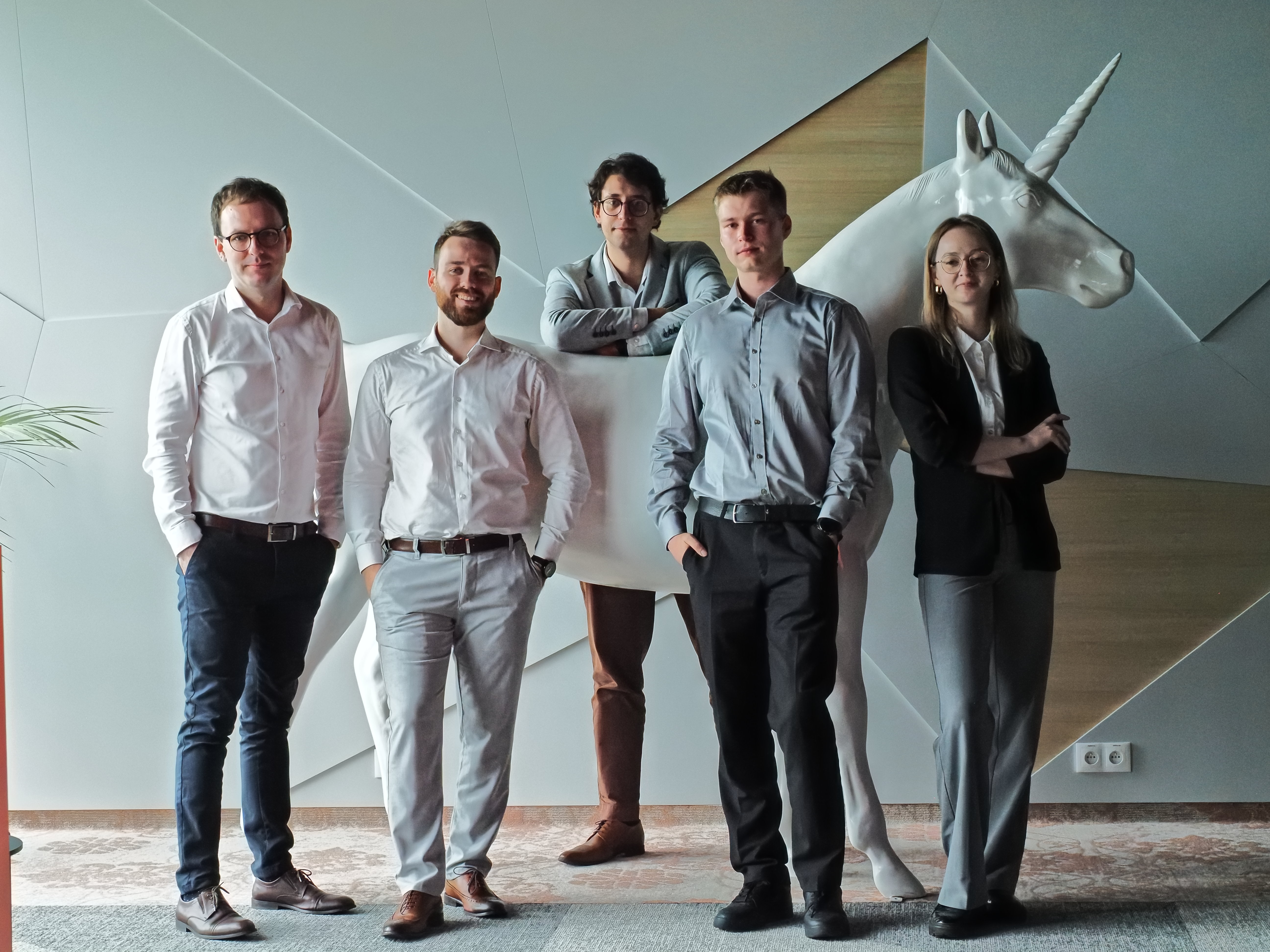
The core of the Gaius Lex team consists of five co‑founders who combine technological, legal and product experience:
Paweł Kulig (CEO) – software engineer with experience at Samsung, Motorola Solutions and Pico, responsible for product development.
Witold Wydmański (CTO) – PhD candidate in computer science at the Jagiellonian University, specialist in NLP and architect of small language models (sLLM); research experience in projects with Harvard, the FDA and Stanford.
Janusz Marszałek (COO) – full‑stack developer responsible for backend, sales automation and operational implementations.
Żaneta Böhm (frontend & data security) – engineer with experience at Adidas Digital and Nokia; develops the frontend and security architecture.
Jakub Kozioł (late co‑founder) – transaction lawyer with over ten years’ experience advising tech companies; supports the company in regulatory, product and strategic matters.
Lawyers need change – the market is just opening up
LegalTech is now one of the hottest segments of AI. The global AI‑in‑law market is expected to grow from USD 1.4 to 3.9 billion by 2030, expanding at over 17% annually.
In parallel with the market’s growth, investor interest is also rising – in just the last dozen or so months Harvey AI has raised more than USD 380 million in total, reaching a valuation of USD 5 billion, EvenUp joined the unicorn club with a USD 135 million round, and Luminance raised USD 115 million in two rounds within a year. Thomson Reuters bought Casetext for USD 650 million, and LexisNexis acquired AI startups from France, Belgium and the UK. All of this is happening because AI adoption among lawyers has exploded: according to the American Bar Association, in the USA the use of AI in law firms rose from 11% to 30% within a single year, and in large firms it’s already 46%. Lawyers cite time savings and increased efficiency as the main benefits, although they are still looking for tools that ensure accuracy, privacy and regulatory compliance.
And in Poland and Central & Eastern Europe? There is still a shortage of solutions that win lawyers over – local, high‑quality, tailored products that take linguistic, legislative and infrastructural realities into account. Gaius Lex is aiming precisely at this gap.
If you’re building a tool that truly solves a complex problem - instead of just slapping AI onto a pitch deck - get in touch. We support teams that test with users from day one, think about scaling globally, and aren’t afraid of markets with challenging regulations or infrastructure.